
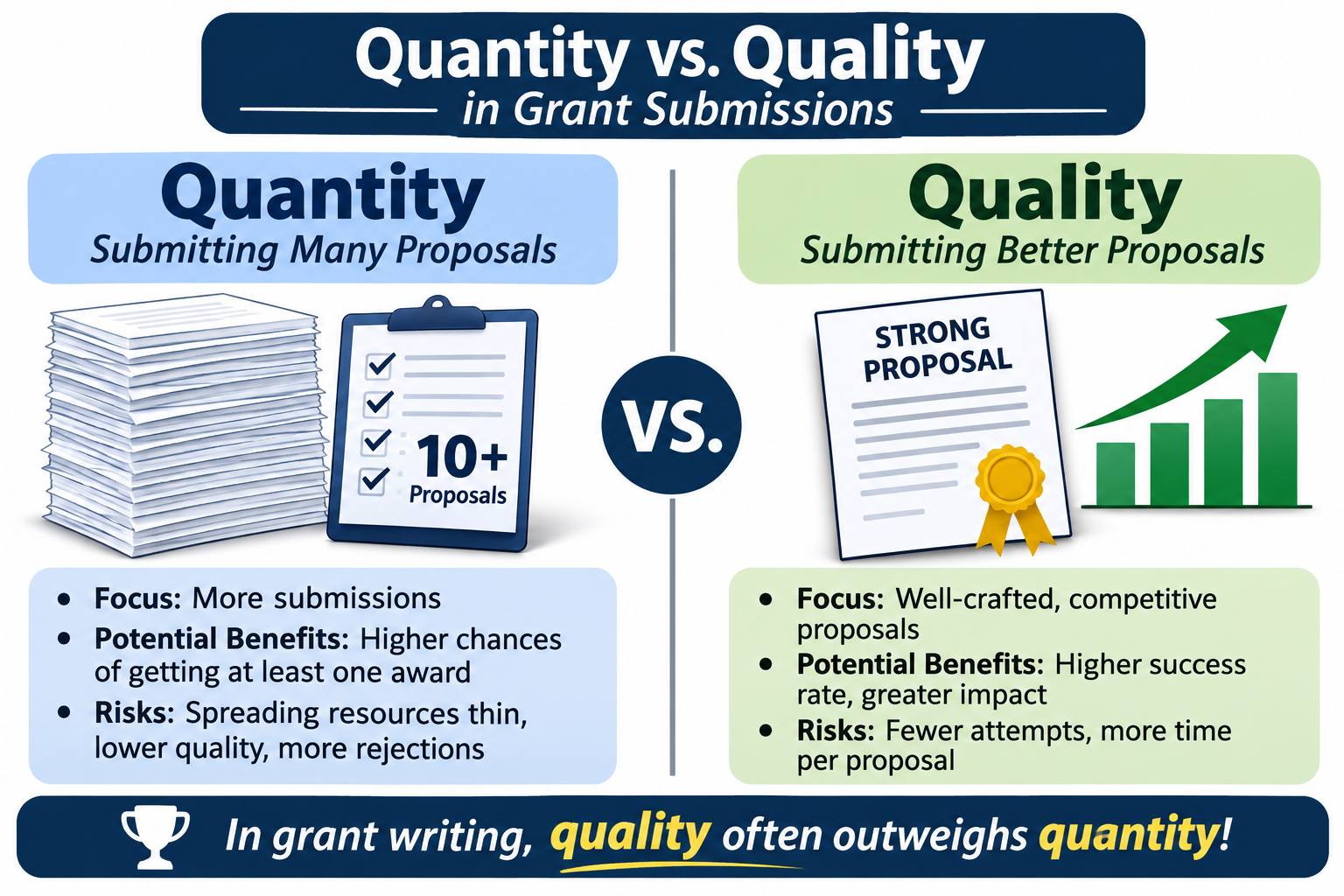
New fundraisers/grant writers often run into this dilemma when formulating an annual or strategic plan for raising money. It is a tough balancing act, to be sure.
Focusing on quantity involves creating templates for generic submissions, which are often concept notes/LOIs that contain a barebones introduction of your nonprofit, impact and project or program that you want funded. This is often called the “shotgun approach,” blasting out 2-3 concept notes per week at your donor prospects and hoping some would stick. Since it is only broadly targeted and you are merely cold-contacting them through emails you dug up via intensive Googling, getting any form of response is usually very rare.
Another drawback with such an approach is that it might become a basis for your performance evaluation as grant developer down the road, where the number of your submissions is compared with your success rate in donor acquisition. In an ideal world, making such an effort would be acceptable as a way of showing you are working hard at being a grant developer. But in real world terms where your KPI is measured in approved grants over a period of time, going shotgun will be seen as an inefficient and lazy method and may cost you your job.
At the other end is the qualitative approach, which aims for a lower and slower rate of submission but is more targeted. This means less use of generic templates and more customization of each submission, especially with full ones where grant-makers want grant-seekers to use their own application templates. It also means going through the normal pre-Ask process of Engagement and Cultivation with every potential donor, which produces the right contacts who can support your nonprofit’s submission. Admittedly, this will take more time, but if one has other prospects that are undergoing the same, developmental process, then the waiting time is shortened and your chances of clinching approvals are improved.
The next time your nonprofit’s leadership breathes down your neck and harries you to speed up grant submissions, tell them about the pitfalls of the shotgun approach, and think about the disastrous performance results lying in wait for you at year’s end (or at the end of your probation period). The popular military saying that “Quantity has a quality of its own” may have won some battles during World War II, but it is hardly a smart principle to follow in the case of grant submissions.